Filmmakers, Screenwriters, Performance, Reviews, Film Reviews, Streaming

OUR HERO, BALTHAZAR
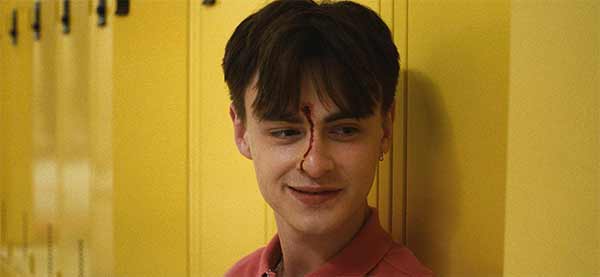
It takes an audacious filmmaker to write and direct a meet-cute rom-com about a school shooting, and a minor miracle for the result to emerge as a confident example of razor-wire satire that delights and appalls in equal measure. The fact that “Our Hero, Balthazar” is Oscar Boyson’s directorial debut makes the whole thing even more impressive — a high-wire act pulled off with the confidence of a seasoned auteur. Like Mary Harron’s divisive “American Psycho,” the film walks a tenuous line between horror and dark comedy, daring the audience to laugh at material that ought to feel unapproachable. Good satire is notoriously hard to get right, demanding careful timing and a delicate harmony between sharp commentary and outright absurdity. Boyson, deftly aided by Matthew Glasner’s dead-accurate casting, sustains the balancing act with quiet assurance. In the film’s opening scene, Balthazar, a teenage rich boy played with striking confidence by Jaeden Martell (”It,” “It Chapter Two”), records multiple takes of a TikTok video responding to a recent school shooting. He begins by clearly faking his emotion, but soon real tears start to flow. Like an actor polishing a self-tape, Balthazar refines his performance until it feels genuinely moving. It’s a chilling portrait of performative grief, one that catches the attention of Solomon, a teenage would-be shooter eager to share his plans for carrying out a massacre at a local high school. From here, the story unfolds through a series of escalating shocks that keep us off-kilter, rapt, and, at times, laughing until its grim yet satisfying finale. What writer-director Boyson is after is nothing less than a full-body CT scan of gun culture and its ties to disenfranchised youth, a probing examination of American exceptionalism, hero worship, and the isolating forces that push young men, rich and poor alike, toward choices they barely understand. Notably, Boyson never lets the film slip into sermonizing. Instead, he cloaks his diagnosis in humor sharp enough to draw blood. When Balthazar flies cross-country to meet up with Solomon, played with a mix of heartbreak and menace by Asa Butterfield (”Hugo”), there is a palpable yet unspoken attraction between the two. An erotically charged scene of Solomon teaching Balthazar how to shoot echoes the famous pistol-comparing moment between John Ireland and Montgomery Clift in “Red River,” where the handling of each other’s guns plays as a barely veiled expression of sexual longing. Much of the film’s heartbreak stems from the boys’ inability to simply ask for what they seem to crave: relief from their loneliness. Repeatedly, one or the other makes a quiet attempt at connection, only to be unknowingly rebuffed, building tension toward an inevitable explosion in which gunfire becomes a substitute for physical contact. The balance between overt symbolism and muted realism creates an atmosphere of uncertainty. Solomon’s estranged father, played with controlled force by Chris Bauer (”True Blood”), runs an MLM selling a testosterone supplement that might as well be called “Powdered Male Toxicity,” while the boys’ scenes together unfold like careful studies in low-key authenticity. One moment we feel safe; the next, we’re covering our eyes in horror. When gun violence becomes so ubiquitous it fades into the background of daily life — just another piece of invisible infrastructure — it’s bracing to encounter a work of art that reminds us the wound is still open. In Boyson’s world, violence becomes the only vocabulary available to boys who lack the language for tenderness. “Our Hero, Balthazar,” layered with painful insight and guided by a quiet call for empathy, suggests that in a society saturated with digital connection yet starved for real intimacy, loneliness may be the real killer. IN THEATERS |
|
An LA-based playwright, JUSTIN TANNER has more than twenty produced plays to his credit, including Voice Lessons, Day Drinkers, Space Therapy, Wife Swappers, and Pot Mom, which received the PEN-West Award for Best Play. He has written for the TV shows Gilmore Girls, My So-Called Life and the short-lived Love Monkey. He wrote, directed and edited 88 episodes of the web series Ave 43, available on YouTube. Tanner is the current Playwright in Residence for the Rogue Machine Theatre in Hollywood, where his most recent play My Son the Playwright, of January of 2026, was met with rave reviews. Travis Michael Holder of the LA Drama Critics Circle wrote, "a phenomenal new achievement by local counter-culture hero Justin Tanner.”
|

To receive a free subscription to our Sunday Lounge! newsletter, Click Here
Have a suggestion? Send an email to the Editor, Click Here